Vintage Bathroom Wall Cabinet Top Factory
Vintage Bathroom Wall Cabinet Top – Factory Production Overview
This page details the engineering and manufacturing considerations for producing the top panel of a vintage‑style wall‑mounted bathroom cabinet. The information focuses on material properties, dimensional tolerances, surface treatment methods, and quality controls that enable repeatable production for OEMs, distributors, and procurement engineers.
Material Selection and Core Construction
The cabinet top is built from a 18 mm thick core of either FSC‑certified pine solid wood or medium‑density fibreboard (MDF) with a density of 0.62 g/cm³. Solid wood cores provide a natural grain pattern suitable for distressing, while MDF offers uniform thickness and minimal movement under humidity changes. Both options are edge‑banded with 0.8 mm PVC or wood veneer to prevent moisture ingress at the exposed edges.
For applications requiring higher load resistance, a hybrid construction uses a 12 mm MDF core sandwiched between two 3 mm hardwood veneer layers, resulting in a flexural modulus of approximately 3.2 GPa. This configuration limits deflection to less than 0.5 mm under a 150 N point load applied at the centre of a 600 mm span.
Dimensional Specifications and Tolerances
Standard panel widths range from 400 mm to 800 mm in 50 mm increments, with lengths from 300 mm to 1200 mm. Thickness is held to ±0.2 mm across the entire surface, verified by laser‑based thickness gauges at five points per panel. The flatness tolerance (maximum deviation from a reference plane) is ≤0.3 mm over a 500 mm measurement length, ensuring proper alignment with adjacent cabinet sides.
Edge profiles are machined to a 2 mm radius or a 45 mm chamfer, depending on the vintage style requested. Profile dimensions are inspected using coordinate measuring machines (CMM) with a repeatability of ±0.05 mm. All dimensions are referenced to ambient conditions of 20 °C and 50 % relative humidity; correction factors are applied for storage or transport environments.
Surface Finish and Aging Techniques
To achieve an authentic vintage appearance, the panel surface receives a multi‑step treatment: (1) a base coat of water‑based primer (dry film thickness 25 µm), (2) hand‑applied stain penetrating 0.1 mm into the wood fibers, (3) distressing via controlled impact tools that create uniform micro‑indentations of 0.3–0.5 mm depth, and (4) a topcoat of natural oil‑wax blend (solid content 35 %) cured at 60 °C for 2 hours. The final coating provides a water‑contact angle of approximately 85°, indicating moderate water resistance while allowing the wood to breathe.
Color consistency is monitored with a spectrophotometer; ΔE*ab values between production batches are kept below 1.5 units. For customers requiring a specific hue, custom stain formulations are available, with pigment concentration adjustable in 0.5 % increments to match reference samples.
Customization Options
- Core material: solid pine, MDF, or hybrid veneer‑sandwich
- Thickness: 15 mm, 18 mm, 22 mm (customizable)
- Edge profile: square, 2 mm radius, 45 mm chamfer, or ogee
- Finish: natural oil‑wax, matte polyurethane, or distressed chalk paint
- Hardware pre‑drilling: hole patterns for hinges, brackets, or concealed mounts
Applications and Installation Considerations
The vintage wall cabinet top is suited for residential bathrooms, boutique hotel suites, and high‑end retail displays where a period‑appropriate aesthetic is required. Its load‑bearing capacity supports typical bathroom accessories such as ceramic sinks (up to 20 kg) and mirrored cabinets when mounted with appropriate brackets rated for at least 150 N shear force. The panel’s low moisture absorption (≤5 % weight gain after 24 h immersion) reduces the risk of swelling in humid environments, provided the edges are sealed with the supplied PVC or veneer edge band.
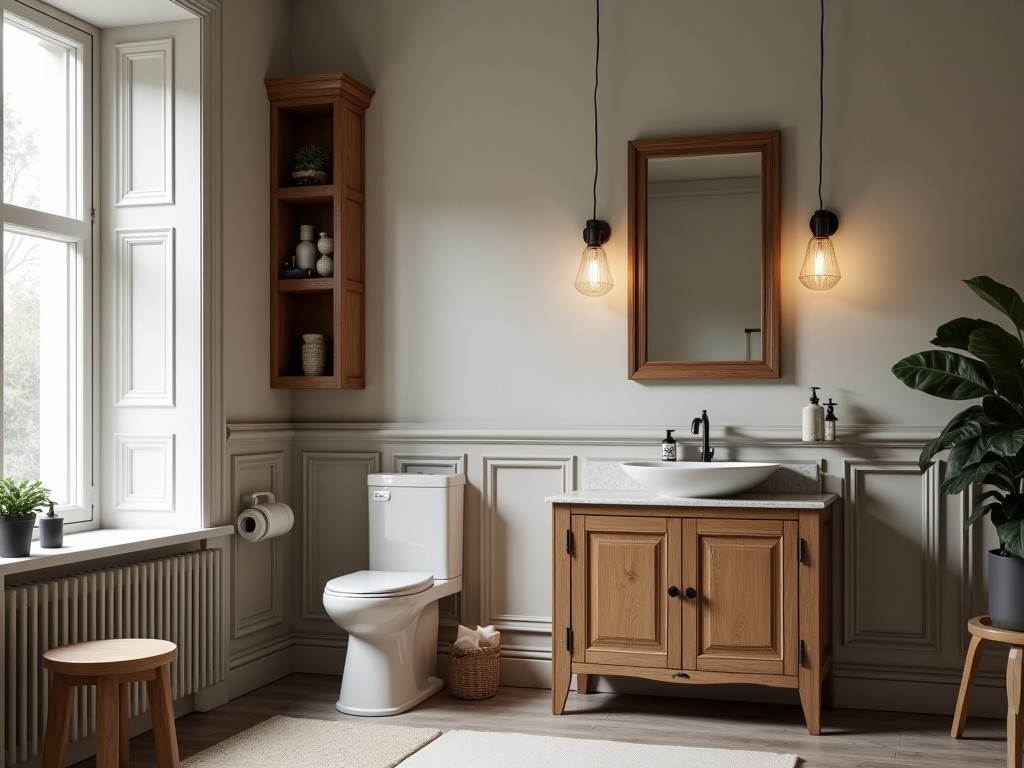
Installation recommends using stainless‑steel screws with a minimum embedment depth of 20 mm into wall studs or reinforced backing boards. A clearance of 2 mm between the panel back and the wall allows for minor expansion and facilitates ventilation. For retrofit projects, the panel can be supplied with pre‑routed channels for concealed wiring or lighting strips, maintaining the vintage appearance while meeting modern electrical codes.
Quality Control and Testing
Each production lot undergoes incoming material inspection: wood moisture content measured to ±0.5 % using capacitance meters, MDF density verified within ±0.02 g/cm³, and veneer adhesion tested per ASTM D906 (peel strength ≥1.2 N/mm). In‑process checks include thickness profiling after machining and visual inspection for surface defects under 500 lux illumination. Final audit involves a batch‑wise functional test: a 100 mm diameter steel ball dropped from 150 mm height onto the panel surface; no cracking or delamination is permitted.
Documentation supplied with each shipment includes a material certificate, thickness measurement report, finish color data (L*a*b* values), and a packing list. Traceability is maintained via laser‑etched lot numbers on the panel back edge, enabling rapid recall if needed.
Packaging and Logistics
Panels are stacked face‑to‑face with interleaving sheets of 0.15 mm polyethylene film to prevent surface abrasion. Corner protectors made of 10 mm recycled polystyrene are applied to all four edges. The assembled pack is placed inside a double‑wall corrugated carton (burst strength ≥275 kPa) and secured with polypropylene straps. For overseas shipments, the carton is lined with a moisture‑barrier bag (water vapour transmission rate ≤0.5 g/m²·day) and sealed with desiccant packets (5 g silica gel) to maintain internal relative humidity below 45 % during transit.
Standard pallet configuration holds 24 panels per pallet (800 mm × 1200 mm footprint), with a maximum stack height of 1.4 m. Pallet weight is approximately 260 kg, allowing safe handling with forklift tines rated for 2 t capacity. Each pallet is labeled with handling instructions, destination marks, and a QR code linking to the product’s technical datasheet.
Frequently Asked Questions
Can dimensions be customized beyond the standard ranges?
Yes. Width, length, and thickness can be adjusted in 1 mm increments based on tooling capabilities. Custom sizes require a new CNC program and may affect lead time; please provide a detailed drawing or DXF file for quotation.
What information is required before a quotation can be issued?
To generate an accurate quote we need: (1) desired core material and thickness, (2) overall dimensions (width × length), (3) edge profile type, (4) finish specification (stain colour, topcoat type, distress level), (5) any pre‑drilled hardware holes or cut‑outs, (6) order quantity, and (7) delivery destination for freight estimation.
How is quality inspected for finish consistency?
Finish colour is measured with a spectrophotometer at five points per panel; the average L*a*b* values must fall within ±1.5 ΔE*ab of the approved gloss‑matched sample. Gloss level is checked at 60° incidence using a gloss meter, with acceptable range of 5‑15 GU for matte oil‑wax finishes.
Contact for Technical Inquiry
For further details on material options, tolerances, or to request a sample panel, please reach out to our engineering team. Provide your project specifications and we will return a detailed response including lead time, pricing, and packaging options.
Submit Inquiry