Solid Wood Freestanding Bathroom Cabinets
Solid Wood Freestanding Bathroom Cabinets
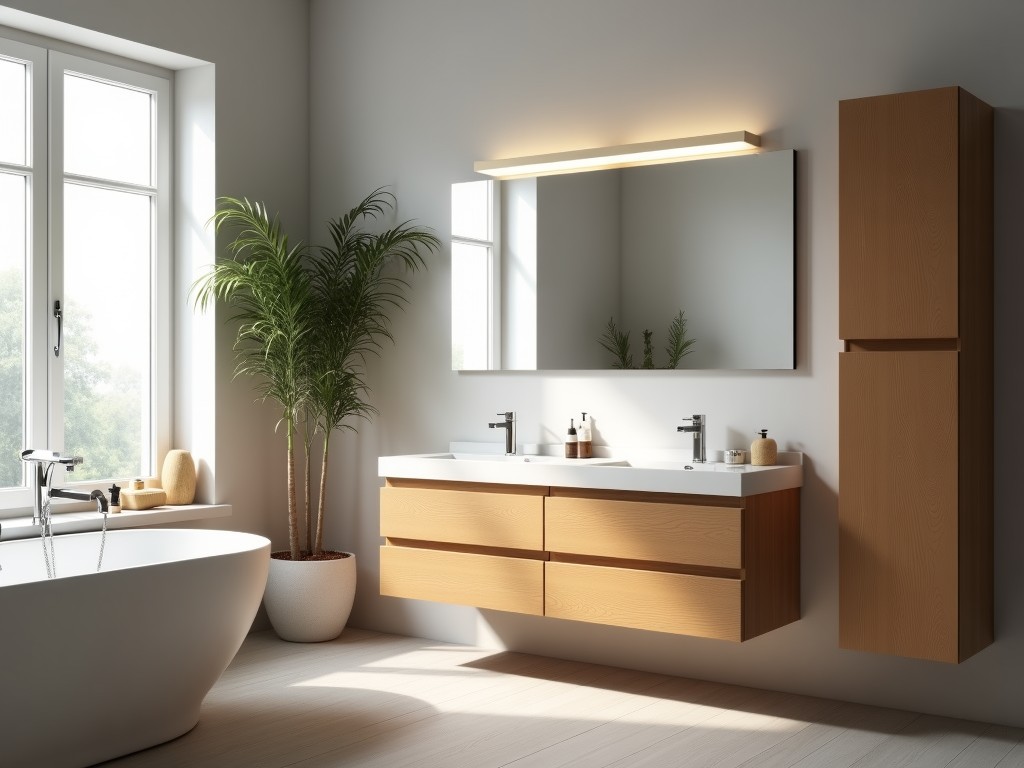
Freestanding cabinets constructed from solid wood provide a monolithic storage solution that resists panel joint movement common in assembled units. Their self‑supporting frame eliminates the need for wall anchoring, simplifying retrofit projects where substrate condition is uncertain.
Material Selection and Wood Species
Primary options include European oak, North American maple, and sustainably harvested teak, each offering distinct density ranges (0.60–0.75 g/cm³) and natural oil content that influences moisture stability. Species are chosen based on project‑specific humidity cycles and finish compatibility rather than aesthetic preference alone.
Construction Methods
Frame‑and‑panel joinery uses mortise‑and‑tenon corners reinforced with blind dowels, providing shear strength exceeding 4 kN per joint under static load. Panels are floated within grooves to accommodate seasonal expansion, preventing cracking while maintaining a flush exterior face.
Dimensional Flexibility and Standard Sizes
Typical widths range from 400 mm to 800 mm in 50 mm increments, heights from 800 mm to 1200 mm, and depths from 350 mm to 500 mm, all adjustable in 25 mm steps without altering structural integrity. Custom lengths beyond 1000 mm require intermediate stretchers to limit deflection under typical wash‑basin loads (<150 kg).
Functional Features
- Soft‑close drawer slides rated for 30 000 cycles, minimizing impact noise in high‑traffic restrooms.
- Adjustable shelving with 32 mm pin increments, allowing reconfiguration for varying toiletries bulk.
- Integrated cable grommets (Ø12 mm) for concealed power routing to LED mirrors or sensor faucets.
Surface Finishing and Protection
Finishes consist of two‑component polyurethane topcoats (dry film thickness 40–60 µm) applied over a penetrating oil‑based primer, delivering a surface hardness of 2H (pencil test) and water vapor transmission rate below 5 g/m²·day. Edge sealing uses hot‑melt polyurethane bead to prevent end‑grain absorption.
Installation Considerations
Units are shipped with adjustable leveling feet (±10 mm range) that compensate for floor unevenness up to 5 mm over a 600 mm span. No permanent floor fastening is required; stability relies on the cabinet’s low center of gravity and foot friction coefficient (>0.4 on typical ceramic tile).
Quality Assurance and Testing
Each cabinet undergoes a 24‑hour conditioned climate test (23 °C/50 % RH) followed by a 48‑hour soak at 90 % RH to verify dimensional change stays under 0.2 %. Load testing applies 150 kg uniformly distributed across the top surface, confirming no permanent deflection >0.5 mm.
Typical Applications in Commercial Bathrooms
In hospitality environments, freestanding cabinets reduce installation time by eliminating wall stud location procedures, allowing rapid room turnover. Healthcare facilities benefit from the absence of wall‑mounted hardware, which simplifies cleaning protocols and reduces microbial harborage points.
Customization Options
Beyond species and dimensions, clients may specify integrated linen drawers with breathable fabric liners, optional lock mechanisms (pin tumbler, 5‑pin), and alternative leg profiles (tapered, square, or concealed caster adapters). All custom features are engineered to maintain the original load path and joint integrity.
Specification Table
| Parameter | Typical Value | Notes |
|---|---|---|
| Wood Density | 0.60–0.75 g/cm³ | Varies by species |
| Joint Shear Strength | >4 kN | Mortise‑and‑tenon with blind dowel |
| Finish Thickness | 40–60 µm | Two‑component polyurethane |
| Load Deflection (150 kg) | <0.5 mm | Uniformly distributed |
| Height Adjustment (feet) | ±10 mm | Compensates floor unevenness |
Frequently Asked Questions
Request a Quote
To discuss project‑specific requirements, submit your specifications via the contact form. Our engineering team will review dimensions, material choices, and hardware options to provide a detailed quotation and lead‑time estimate.
Contact Us