Small Freestanding Bathroom Vanity Cabinet
Small Freestanding Bathroom Vanity Cabinet
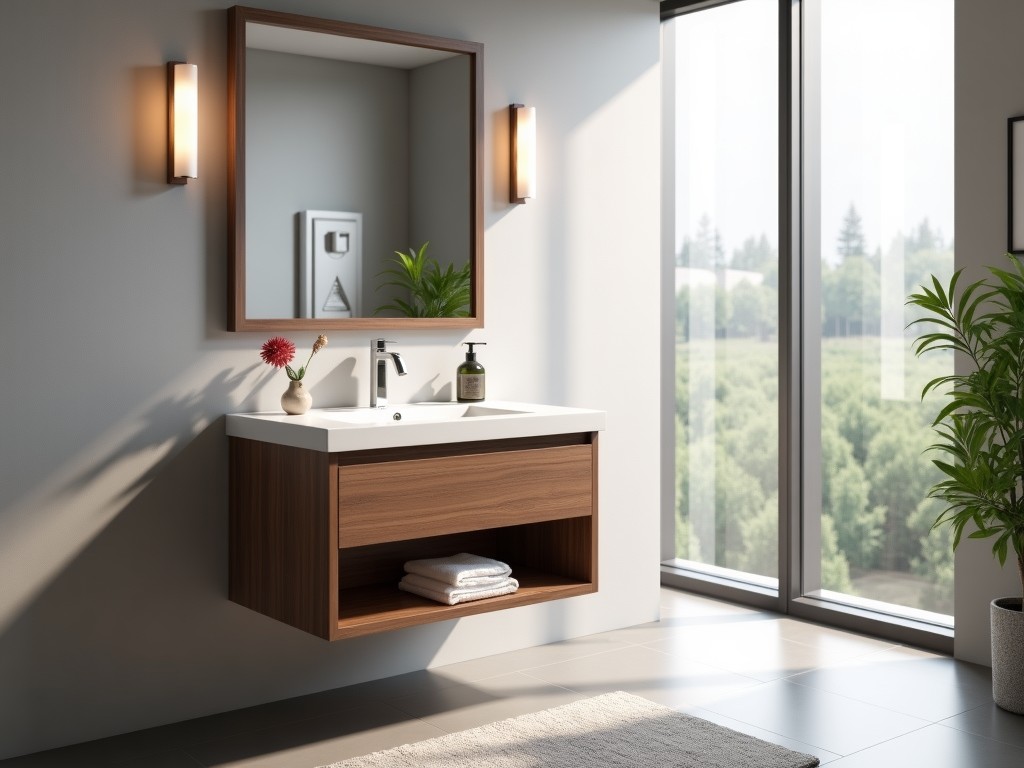
This unit is designed as a self‑supporting storage element for compact bathrooms, featuring a rigid frame and integrated countertop that eliminates the need for wall mounting.
Design Construction
The carcass consists of 18 mm thick moisture‑resistant particleboard core faced with a melamine laminate on all exterior surfaces. Edges are sealed with 0.5 mm PVC edge banding to prevent water ingress.
A full‑extension drawer system uses concealed ball‑bearing slides rated for 30 kg dynamic load per pair, providing smooth operation even when loaded with toiletries.
Typical Dimensions and Weight
| Parameter | Value |
|---|---|
| Overall width | 600 mm |
| Overall depth | 460 mm |
| Overall height (including countertop) | 850 mm |
| Cabinet carcass thickness | 18 mm |
| Drawer load capacity (per pair) | 30 kg |
| Total unit weight (unpacked) | 22 kg |
Material and Finish Options
Core panels are available in three moisture‑resistant grades: standard particleboard, high‑density fiberboard (HDF), and marine‑grade plywood. Each grade is offered with a choice of melamine, PVC‑film, or low‑pressure laminate (LPL) surface finishes.
- Standard particleboard – 18 mm thickness, density 650 kg/m³, suitable for indoor bathroom environments with relative humidity up to 70 %.
- HDF – 18 mm thickness, density 850 kg/m³, increased impact resistance and reduced swelling.
- Marine plywood – 18 mm thickness, 5‑ply cross‑bonded, water‑boil proof (WBP) adhesive, ideal for wet zones.
Surface finishes are rated for abrasion resistance (Taber test) of 150 mg loss per 1000 cycles for melamine, 80 mg for PVC‑film, and 60 mg for LPL.
Installation and Site Requirements
The cabinet stands on four adjustable leveling feet, each providing up to 15 mm vertical adjustment to compensate for uneven flooring. Load is transferred directly to the floor through a 30 mm square steel foot plate, reducing point load concentration.
No wall anchors are required, making the unit suitable for retrofit projects, temporary installations, or buildings where drilling into studs is prohibited. Plumbing connections are accessed via a rear cut‑out measuring 120 mm × 80 mm, positioned 100 mm above the base.
Electrical provisions for illuminated mirrors or outlet strips can be accommodated through a 25 mm diameter grommet located in the rear panel.
Typical Applications
In compact ensuites where wall studs are spaced at 600 mm intervals, a freestanding vanity avoids the need to reinforce or relocate plumbing fixtures, preserving the existing layout.
Hotel refurbishment projects often require rapid room turnover; a unit that can be positioned and leveled within 20 minutes reduces labor cost and minimizes downtime.
Assisted living facilities benefit from the ADA‑compliant clear floor space underneath the cabinet, which provides a minimum of 660 mm width for wheelchair maneuvering when the vanity depth is 460 mm.
Quality Control and Testing
Each panel is inspected for thickness variation (±0.2 mm) and surface gloss uniformity using a handheld reflectometer; batches exceeding a 5 % deviation are segregated.
Drawer slides undergo a cycle test of 50 000 open‑close operations at 20 kg load, with performance recorded for friction coefficient and lateral play.
Finished units are subjected to a 24‑hour humidity soak at 80 % RH and 30 °C, after which dimensional change is measured; acceptable swelling is limited to 0.3 % in thickness and 0.1 % in length.
Can the overall dimensions be customized?
Width, depth and height can be adjusted in 10 mm increments within the range 500–800 mm wide, 380–550 mm deep, and 750–950 mm high, subject to structural validation of the carcass and drawer hardware.
What information is required for a quotation?
To generate a quote we need the desired overall dimensions, selected core material, surface finish, drawer configuration (number and height), and any special cut‑outs for plumbing or electrical.
How is quality inspected before shipment?
Each unit receives a visual inspection for surface defects, a functional test of drawer operation, and a dimensional verification against the approved drawing; a QC sign‑off form is attached to the packaging.