Factory Price Bathroom Wall Hung Storage Cabinet
Factory Price Bathroom Wall Hung Storage Cabinet
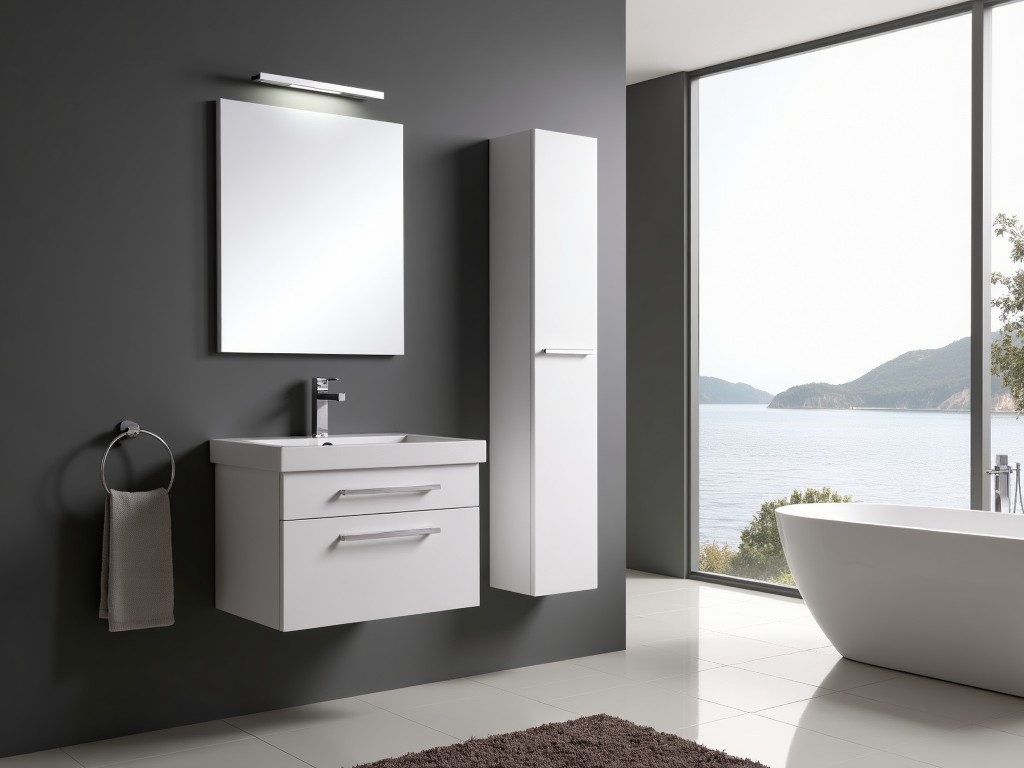
Wall hung storage cabinets are mounted directly to the bathroom wall, eliminating floor contact and facilitating unobstructed cleaning. This configuration reduces the risk of water damage to the cabinet base and provides a streamlined appearance suitable for high‑traffic commercial environments.
Material Selection and Construction
The primary structure is formed from cold‑rolled steel sheet with a thickness ranging from 0.8 mm to 1.2 mm, providing a balance between weight and rigidity. For environments requiring enhanced corrosion resistance, stainless steel grade 304 or marine‑grade aluminum alloy 5052 may be substituted.
All joints are continuously welded using robotic MIG equipment, followed by grinding to achieve a smooth finish. Reinforcement brackets are welded at each corner and at mid‑span to distribute loads evenly across the mounting plane.
After welding, the cabinet undergoes a pretreatment phosphate wash, then receives a thermoset powder coating applied via electrostatic spray. Typical coating thickness is 60–80 µm, measured with a magnetic gauge.
Dimensional Options and Customization
Standard sizes are offered to accommodate common bathroom layouts, while custom dimensions can be engineered to meet specific project requirements. The table below illustrates typical adjustable ranges.
| Dimension | Typical Range (mm) | Customizable? |
|---|---|---|
| Overall Width | 400 – 1200 | Yes, in 50 mm increments |
| Overall Height | 600 – 2000 | Yes, in 50 mm increments |
| Overall Depth | 150 – 350 | Yes, in 25 mm increments |
| Shelf Clearance (inner) | 100 – 300 | Yes, per shelf |
| Door Thickness | 18 – 25 | Optional, based on material |
Load Bearing Capacity and Structural Performance
Each shelf is designed to support a uniformly distributed load of up to 25 kg when the cabinet is mounted to a concrete substrate using M8 chemical anchors. The load rating is derived from finite‑element analysis validated by static test to 1.5× the rated load without permanent deformation.
The mounting brackets incorporate a 4 mm thick steel gusset that transfers shear forces to the wall. Cycle testing of the bracket‑wall interface shows no loss of torque after 5000 load‑unload cycles at 75 % of the rated load.
Surface Finish and Corrosion Resistance
Powder coated finishes are evaluated per ASTM D3359 for adhesion (cross‑hatch test) and typically achieve a rating of 5B. Salt spray exposure following ASTM B117 demonstrates no red rust after 500 hours for the standard coating, and up to 1500 hours for the optional epoxy‑primer base.
For stainless steel variants, the surface retains a mill finish with a measured roughness average (Ra) of 0.4 µm, suitable for frequent cleaning with mild detergents.
Installation and Mounting Requirements
The cabinet is supplied with two concealed steel mounting plates, each featuring four M8 threaded inserts. Installation requires drilling pilot holes into the wall substrate, inserting appropriate anchors (chemical for concrete, toggle for hollow studs), and securing the plates with M8×60 mm socket head cap screws.
Recommended vertical spacing between the plates is 80 % of the cabinet height to minimize bending moment. A level should be used to ensure the mounting plane is within 2 mm of horizontal over the cabinet width.
Applications in Commercial and Industrial Facilities
Wall hung cabinets are favored in hotels, hospitals, and public restrooms where floor space must remain clear for carts and cleaning equipment. The elevated position reduces the likelihood of impact damage from floor‑mounted fixtures and simplifies mopping procedures.
In laboratories and pharmaceutical settings, the smooth, non‑porous surface minimizes particle retention and supports compliance with hygiene standards such as ISO 14644‑1 Class 7.
Quality Assurance and Inspection
Incoming steel coil is inspected for thickness tolerance (±0.02 mm) and surface defects using ultrasonic gauging and visual checks under 500 lux illumination. Dimensional verification of cut panels is performed on a CNC measuring arm with repeatability of ±0.1 mm.
After coating, adhesion and thickness are measured on each batch; any panel falling below 55 µm coating or adhesion below 4B is reworked. Final assembly includes a functional test of door hinges (10 000 cycles) and load verification of each shelf.
Packaging and Logistics
Each cabinet is wrapped in polyethylene film, placed in a double‑wall corrugated carton with die‑cut foam corners, and sealed with pressure‑sensitive tape. Cartons are palletized (standard 1200 × 1000 mm) and stretch‑wrapped for stability.
Labeling includes part number, dimensions, weight, and QR code linking to the installation manual. Typical gross weight per unit ranges from 8 kg (small) to 22 kg (large), influencing freight class calculations.
Frequently Asked Questions
Can dimensions be customized? Yes, width, height, and depth can be adjusted in increments as noted in the dimensional table, subject to tooling constraints.
What information is required before quotation? Project‑specific dimensions, material preference (steel, stainless steel, aluminum), finish type, and quantity.
What materials are available? Cold‑rolled steel (0.8–1.2 mm), stainless steel 304, and aluminum alloy 5052, each with optional powder coat or anodized finish.
How is quality inspected? Incoming material verification, dimensional checks, coating adhesion and thickness tests, hinge cycle testing, and load validation.
What packaging methods are available? Standard corrugated cartons with foam corner protection; palletizing and stretch‑wrapping are standard for bulk orders.
How are export shipments protected? Cartons are sealed with moisture‑resistant tape, pallets are fitted with edge boards, and shipments are secured with polyester strapping.
What is the typical production lead time? Lead time varies from 2 weeks for stock sizes to 4–6 weeks for fully customized orders, depending on material availability.
How are samples arranged? Samples can be produced upon request; sample cost is credited against a subsequent order.