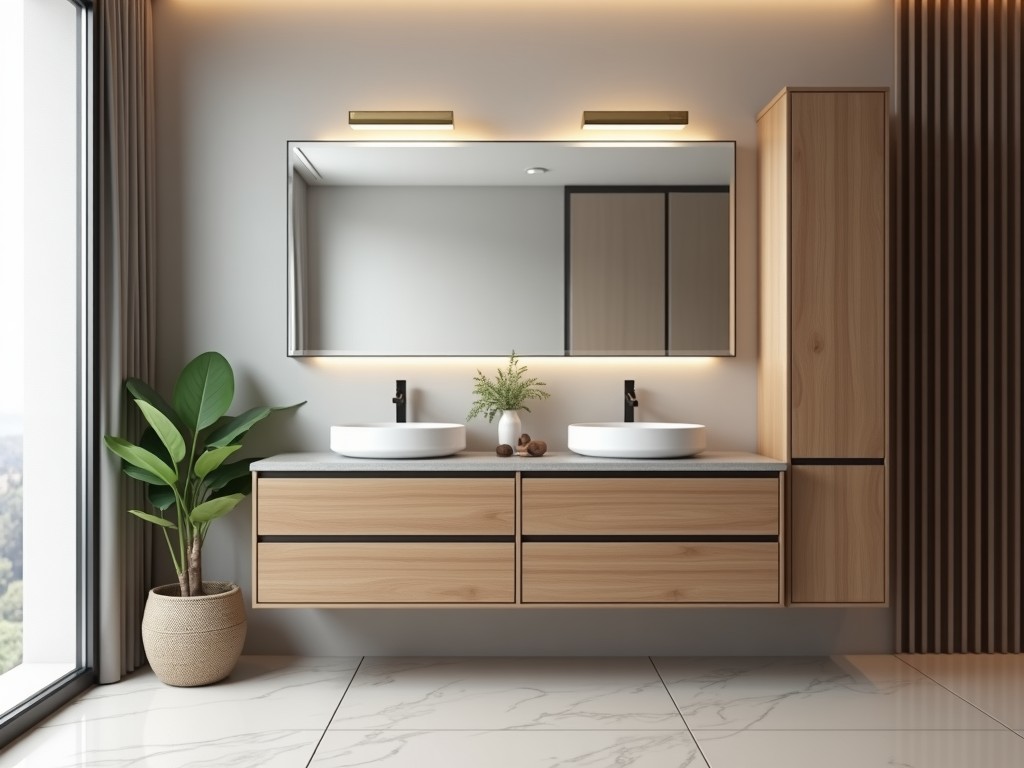
Custom Factory Built In Bathroom Cabinets
Custom Factory‑Built Bathroom Cabinets
Factory‑assembled bathroom cabinetry reduces on‑site labor, improves dimensional repeatability, and minimizes exposure to moisture during installation. Engineers specify these units when project schedules demand rapid fit‑out and when long‑term performance in humid environments is critical.
Design and Engineering Considerations
Load calculations start with the weight of countertops, fixtures, and anticipated dynamic loads from cleaning equipment. Cabinet frames are designed to resist deflection under a uniform load of 150 N per shelf, using a safety factor of 1.5 based on ANSI/BIFMA X5.5 standards.
Moisture barrier design incorporates a minimum 0.2 mm PVC edge seal on all exposed panel edges and a rear ventilated gap of 5 mm to allow vapor equalization. These details prevent swelling and maintain dimensional stability over a 10‑year service life in environments with relative humidity up to 80 %.
Material Selection
Core panels are typically manufactured from 18 mm moisture‑resistant MDF (MR‑MDF) with a density of 700 kg/m³, providing a balance of stiffness and weight. For high‑impact zones, 12 mm marine‑grade plywood with a face veneer of phenolic‑impregnated birch is available.
- MR‑MDF core: thickness 16‑22 mm, tensile strength ≥ 25 MPa, swelling ≤ 2 % after 24 h water immersion.
- Marine plywood: 5‑ply, adhesive Type II, surface roughness Ra ≤ 4 µm.
- Finish options: UV‑cured acrylic coating (gloss 80 ± 5 GU), melamine laminate (ISO 4586‑2 Class 1), or powder‑coated steel frame (thickness 60 µm, hardness 2H).
Fabrication Process
Panels are cut on CNC routers with a positional accuracy of ±0.1 mm, ensuring repeatable joint geometry. Edge banding is applied using hot‑melt adhesive at 180 °C, achieving a peel strength of ≥ 1.2 N/mm.
Assembly utilizes cam‑lock fasteners and pre‑drilled dowel holes, allowing disassembly for maintenance without compromising alignment. All hardware is zinc‑plated to ASTM B633, Fe/Zn 5, providing corrosion resistance in chloride‑rich atmospheres.
Dimensional Tolerances and Installation
| Parameter | Typical Tolerance | Verification Method |
|---|---|---|
| Overall height (finished) | ±2 mm | Laser distance meter, three points per unit |
| Cabinet width (inside) | ±1.5 mm | Caliper measurement at mid‑span |
| Shelf depth | ±1 mm | Template gauge, three locations |
| Door overlay | ±0.5 mm | Feel‑er gauge set |
| Hardware hole location | ±0.2 mm | CMM probe, automated |
Installation employs a leveling shim system with adjustable steel brackets, allowing compensation for floor variations up to 10 mm. Fasteners are torqued to 2.5 Nm (±10 %) to prevent creep under sustained load.
Quality Assurance
Each batch undergoes a first‑article inspection covering dimensional checks, adhesive bond strength, and finish adhesion (cross‑hatch test per ASTM D3359, rating 5B). Statistical process control monitors key dimensions with a Cp ≥ 1.33.
Final audit includes a 48‑hour humidity cycling test (30 % ↔ 80 % RH at 25 °C) followed by visual inspection for delamination, warping, or finish defects. Units that pass receive a traceable QR code linking to the inspection record.
Applications in Industrial Facilities
In pharmaceutical manufacturing, bathroom cabinets must resist frequent cleaning with hydrogen peroxide‑based agents; the UV‑cured acrylic finish shows no measurable gloss loss after 200 cycles of 5 % H₂O₂ exposure (ISO 2812‑1).
Food‑processing plants require surfaces that inhibit microbial growth; the melamine laminate option provides a non‑porous surface with a measured bacterial retention of < 10 CFU/cm² after ISO 22196 testing.
Heavy‑duty workshops benefit from powder‑coated steel frames, which retain structural integrity after 500 h of salt‑spray exposure (ASTM B117) with < 5 % loss of yield strength.
Customization Workflow
Clients submit a CAD layout or sketch indicating fixture locations, required accessories (e.g., towel bars, soap dispensers), and finish preferences. Our engineering team reviews the file for manufacturability, generates a DFM report, and returns a quotation within three business days.
Upon approval, a prototype panel is produced for fit‑check; feedback is incorporated before full‑run production. Lead time for standard configurations is typically four weeks, with expedited options available for project‑critical schedules.
Next Steps
To discuss technical requirements, request a detailed quotation, or arrange a sample panel, please contact our sales engineering team.
Request a Quote