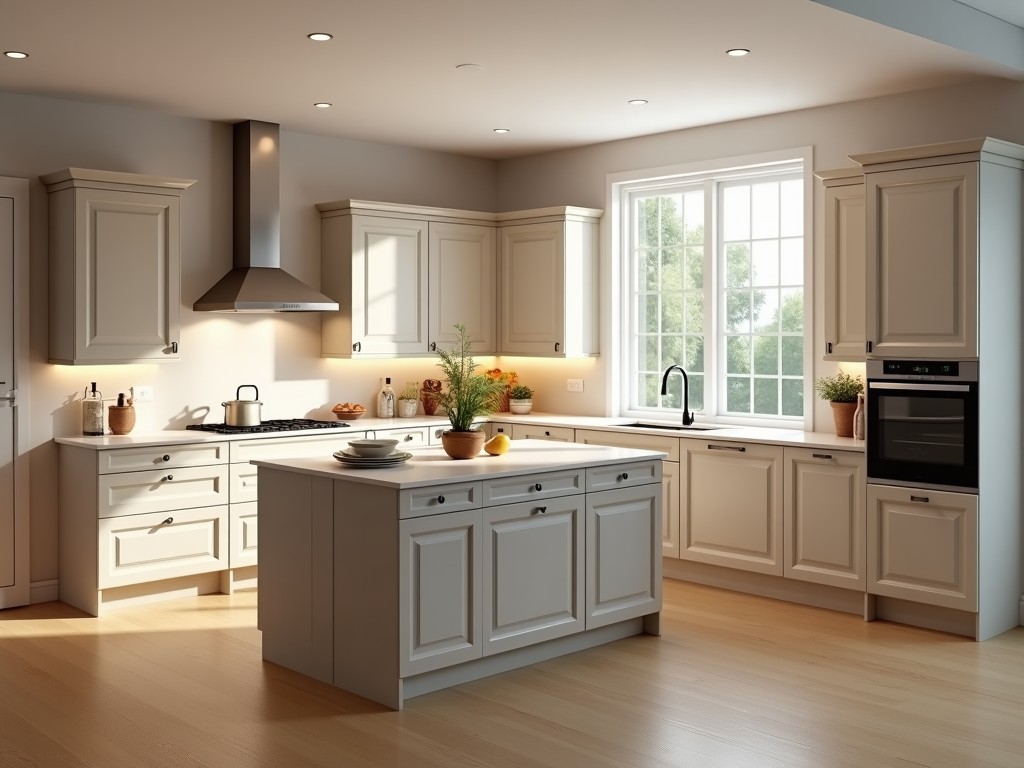
Buy Custom Kitchen And Bathroom Cabinets
Buy Custom Kitchen and Bathroom Cabinets
Custom cabinets are fabricated to match the exact dimensions, material specifications, and hardware requirements of a particular project, eliminating the need for field modifications and reducing installation time. By specifying panel thickness, substrate type, edge treatment, and finish system during design, owners and contractors can achieve predictable performance in load bearing, moisture resistance, and surface durability.
Substrate Materials and Construction Details
Three common substrates are used: 18 mm particleboard with a nominal density of 650 kg/m³ and modulus of rupture approximately 16 MPa; 18 mm medium‑density fiberboard (MDF) at 700 kg/m³ density and 20 MPa modulus of rupture; and 18 mm five‑ply plywood with cross‑laminated layers, density 550 kg/m³ and modulus of rupture 22 MPa. Each panel receives a 0.5 mm PVC edge band or a 2 mm real‑wood veneer bonded with hot‑melt adhesive, providing a seamless edge that resists chipping and moisture ingress.
Dimensional Tolerances and Modularity
Cabinets are produced to a width tolerance of ±0.5 mm, height tolerance of ±0.5 mm, and depth tolerance of ±0.5 mm, ensuring tight alignment with adjacent units and walls. Standard modular increments are 100 mm, allowing designers to create runs that fit typical room layouts while custom widths can be specified in 1 mm steps to accommodate uneven surfaces. Scribe strips of 12 mm width are available for on‑site adjustment without compromising structural integrity.
Hardware Specifications
- European concealed hinges: 110° opening angle, torque rating 2.5 Nm per hinge, nickel‑plated steel.
- Full‑extension ball‑bearing drawer slides: load capacity 45 kg per pair, travel length equal to drawer depth, anti‑rebound mechanism.
- Soft‑close dampers: hydraulic damping providing 0.2 s closing speed, adjustable closing force.
- Cam‑lock fasteners: shear strength 1.8 kN, tensile strength 2.2 kN, tool‑free installation.
Manufacturing Workflow
Panels are cut on a CNC saw with positioning accuracy of ±0.1 mm, followed by edge banding using a hot‑melt adhesive applicator that applies 0.2 mm glue line at 200 °C. CNC boring machines drill hinge and slide holes to ±0.2 mm positional tolerance. Surfaces are sanded to 120‑grit before UV‑cured lacquer application, achieving a dry film thickness of 2 mil and a pencil hardness of 2H. Assembly employs cam‑lock connectors tightened to a torque of 0.8 Nm, providing joint stiffness suitable for typical cabinet loads.
Quality Assurance and Testing
Incoming particleboard is checked for moisture content below 8 % using a capacitance meter. Finished panels undergo dimensional verification on a coordinate measuring machine, with acceptable deviation limited to ±0.3 mm. Finish adhesion is evaluated by ASTM D3359 cross‑hatch test, requiring a rating of 5B (no peeling). Shelf load tests apply a uniformly distributed load of 50 kg/m² for 24 hours; deflection must remain under 2 mm. A final visual inspection checks for edge band uniformity, finish gloss consistency (60‑degree gloss 30 ± 5 GU), and hardware alignment.
Typical Applications and Performance Rationale
In hospitality environments, cabinets are exposed to frequent cleaning with alkaline agents; the UV‑cured lacquer provides chemical resistance rated to 10 % sodium hydroxide for 30 minutes without loss of gloss. Healthcare facilities benefit from seamless edges that prevent microbial harborage and the option to specify antimicrobial additive in the finish layer. Multi‑family residential projects value the rapid turnover enabled by factory‑finished units that require no on‑site painting, reducing VOC exposure during occupancy. Laboratory installations often select plywood substrate with a phenolic‑resin finish, offering resistance to solvents and acids up to 5 % concentration.
Material Option Comparison
| Material | Thickness (mm) | Density (kg/m³) | Modulus of Rupture (MPa) | Moisture Resistance | Typical Finish Compatibility |
|---|---|---|---|---|---|
| Particleboard | 18 | 650 | 16 | Dry interior only | Melamine, UV lacquer |
| MDF | 18 | 700 | 20 | Interior, low humidity | Paint, UV lacquer, veneer |
| Plywood (5‑ply) | 18 | 550 | 22 | Humid zones, occasional splash | Veneer, laminate, UV lacquer |
Frequently Asked Questions
Can dimensions be customized? Yes. Width, height, and depth can be specified in 1 mm increments, with standard modular steps of 100 mm for efficient material usage.
What information is required before quotation? Project drawings showing cabinet layout, required interior accessories (shelves, drawers), substrate preference, finish system, and hardware selections.
Which materials are available for wet areas? Five‑ply plywood with phenolic‑resin finish or marine‑grade particleboard with edge sealing are recommended for environments with regular water exposure.
How is quality inspected? Incoming material moisture content, dimensional accuracy via CMM, finish adhesion cross‑hatch test, shelf load deflection, and final visual check are performed on every batch.
What packaging methods are available? Cabinets are packed in flat‑pack cartons with corner protectors, stretch‑wrapped pallets, or fully assembled crates with foam cushioning, depending on destination and handling requirements.
What is the typical production lead time? Lead time ranges from 3 to 4 weeks after drawing approval, subject to material availability and order complexity.
Request a Quote
To begin a custom cabinet project, submit your layout drawings, material preferences, and hardware specifications via the contact form. Our engineering team will review the files, provide a detailed quotation, and outline the production schedule.
Please contact us to start the quotation process.