Buy Best Bathroom Mirror Cabinets
Bathroom Mirror Cabinets – Technical Overview
These units combine a sealed storage compartment with a front-facing mirror, designed to withstand continuous exposure to water vapor, splashes, and cleaning agents commonly found in wet environments.
Core performance criteria include resistance to delamination, maintenance of optical clarity after prolonged humidity cycles, and structural integrity under repeated door opening/closing forces.
Material Selection and Measurable Properties
Typical cabinet bodies are fabricated from marine‑grade plywood (minimum 12 mm thickness, density ≈ 600 kg/m³) or extruded aluminum alloy 6063‑T5 (wall thickness 1.2 mm, tensile strength ≥ 200 MPa). Both options provide a barrier to water ingress when edges are sealed with polyurethane‑based edge banding.
The mirror substrate is usually tempered soda‑lime glass (≥ 4 mm thickness, surface compression ≥ 90 MPa) coated with a silver‑nitride reflective layer and a protective paint backing that passes the ASTM B117 salt‑spray test for 500 hours without visible corrosion.
Hardware components such as hinges, handles, and latch mechanisms are selected from stainless steel grade 304 with a minimum 5 mm pin diameter, ensuring a rated cycle life of 50 000 operations under a 15 N load.
Typical Specification Table
| Parameter | Typical Value / Range |
|---|---|
| Overall Height | 600 mm – 900 mm (customizable) |
| Overall Width | 400 mm – 800 mm (customizable) |
| Body Depth | 120 mm – 180 mm (including door protrusion) |
| Door Opening Angle | 110° ± 5° |
| Maximum Shelf Load | 15 kg per shelf (uniformly distributed) |
| Ingress Protection (IP) Rating | IP44 (protected against splashing water from any direction) |
| Electrical Supply for LED Lighting | 12 V DC, 5 W per linear foot, dimmable via PWM |
Customization Options (selected for readability)
- Overall dimensions adjusted in 10 mm increments to match wall stud spacing
- Lighting type: edge‑lit LED strips (CRI ≥ 90, 3000 K–6000 K selectable) or integrated fluorescent tubes
- Anti‑fog heater pad (power density 120 W/m², controllable via humidity sensor)
- Interior accessories: adjustable glass shelves, magnetic strips, or pull‑out trays
- Finish options: powder‑coated aluminum (RAL colors), laminate veneer, or clear anodized coating
Application Rationale for Bathroom Environments
The combination of a sealed enclosure and a mirror addresses two simultaneous needs: storage of toiletries and a functional grooming surface. In spaces where relative humidity regularly exceeds 70 %, materials that resist swelling and corrosion prevent long‑term degradation that would otherwise compromise door alignment and mirror adhesion.
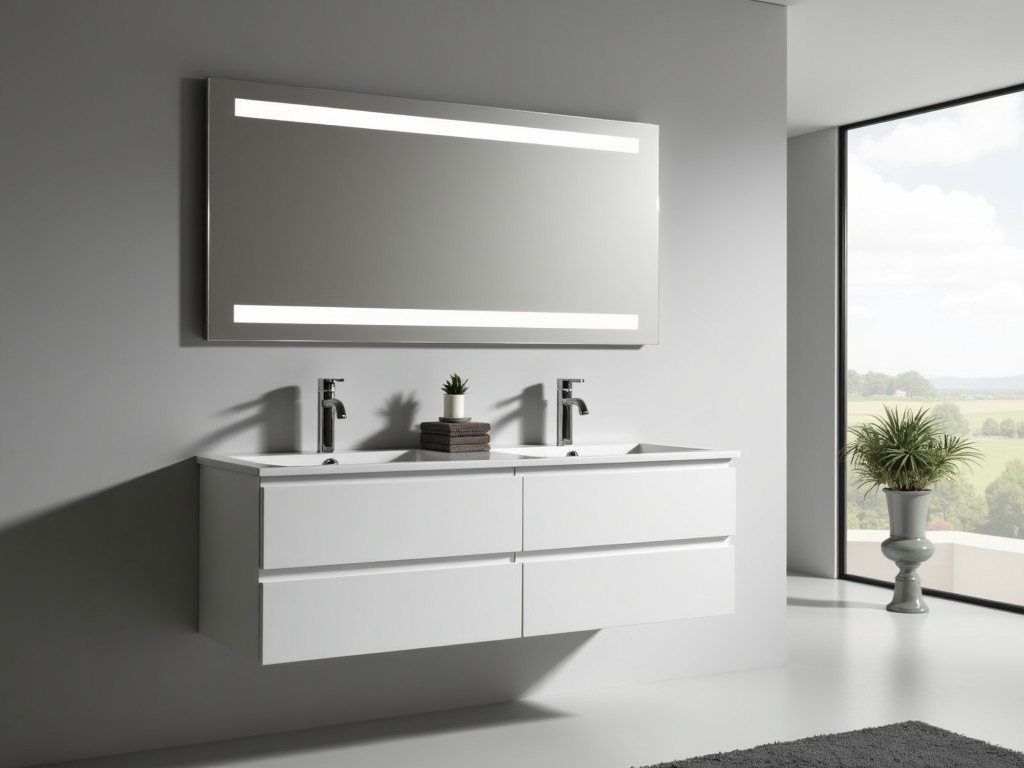
Integrated LED illumination provides task‑level lighting (minimum 300 lx at the mirror plane) while minimizing heat buildup, which helps maintain stable temperature across the glass substrate and reduces the risk of thermal stress cracking.
Quality Control Philosophy
Each production lot undergoes dimensional verification (± 0.5 mm on critical features), adhesion testing of the reflective coating (cross‑hatch method per ISO 2409), and a cyclic humidity test (40 °C/93 % RH for 24 h, repeated 10 cycles) to confirm no delamination or corrosion.
Functional checks include hinge torque measurement (target 0.25 Nm ± 0.02 Nm), lighting intensity validation, and anti‑fog pad temperature uniformity (< 5 °C variance across the pad surface).
Frequently Asked Questions
A: Yes, width, height, and depth are adjustable in 10 mm increments based on project‑provided opening measurements.
A: Desired overall size, material preference (plywood or aluminum), lighting specifications, any optional features (defogger, sensors), and quantity.
A: Powder‑coat in any RAL color, clear anodize (10 µm thickness), or brushed satin finish; all undergo a 500‑hour salt‑spray validation.
A: Each cabinet is placed in a double‑wall corrugated carton with corner protectors, surrounded by 5 mm polyethylene foam, and sealed with moisture‑barrier film; pallets are stretch‑wrapped and secured with PET straps.
A: Typically 3–4 weeks after approval of final drawings, subject to material availability and finish complexity.
Next Steps
For a detailed technical datasheet, sample request, or to discuss project‑specific requirements, please use the contact form below.
Submit Inquiry