Bathroom Vanity Cabinets Wholesale Supplier
Bathroom Vanity Cabinets Wholesale Supplier
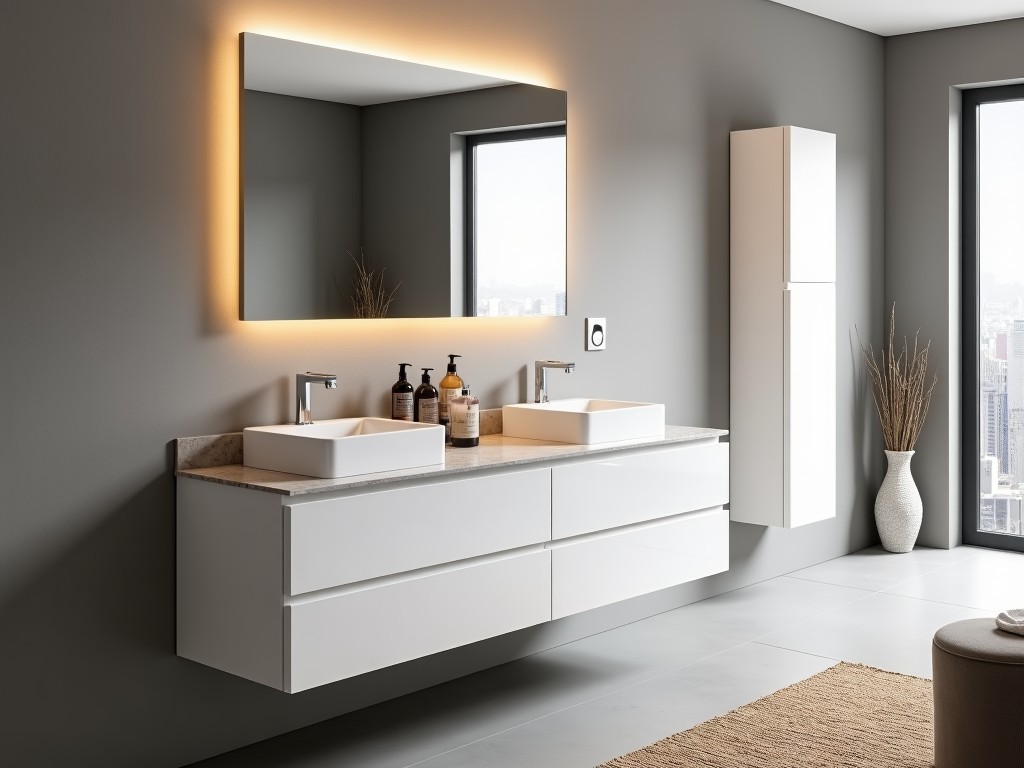
Bathroom vanity cabinets serve as the primary storage unit beneath lavatories in commercial restrooms, combining structural support for countertops with organized space for toiletries and cleaning supplies. Their performance depends on resistance to humidity, cleaning agents, and repeated loading cycles typical of high‑traffic facilities. Selecting the right construction approach reduces maintenance frequency and extends service life in hospitality, healthcare, and multifamily projects.
Core Construction Materials
Panel substrates are chosen based on dimensional stability, moisture resistance, and cost targets. Medium density fiberboard (MDF) provides a uniform surface for paint or laminate finishes and exhibits a typical density of 650‑750 kg/m³. Particleboard offers lower material cost with densities around 450‑550 kg/m³ but requires edge sealing to limit water ingress. Plywood cross‑band layers deliver higher bending strength and are often selected for heavy‑load applications where panel thickness exceeds 18 mm.
- Solid wood strips or veneers are used for premium aesthetics, providing natural grain variation and a typical density of 500‑700 kg/m³ depending on species.
- Moisture‑resistant additives such as melamine‑urea‑formaldehyde resins are incorporated into MDF and particleboard to achieve a swelling rating below 5 % after 24 h water immersion.
- Edge protection options include PVC banding, ABS edging, or wood veneer tape, each selected to match substrate expansion coefficients and finish compatibility.
Dimensional Standards and Customization
Standard vanity cabinets for commercial bathrooms commonly follow a width increment of 150 mm, ranging from 450 mm to 1800 mm to accommodate single or double lavatory configurations. Nominal height is typically 800 mm to align with ergonomic countertop levels, while depth varies between 450 mm and 550 mm to suit different plumbing rough‑ins. Adjustable shelving systems use 25 mm pitch holes, allowing reconfiguration without tools.
Customization extends to cut‑outs for plumbing fixtures, integrated toe kicks, and optional hardware such as soft‑close hinges or full‑extension drawer slides. Panel thicknesses can be specified from 12 mm to 25 mm based on load requirements, with corresponding adjustments to reinforcement brackets. All dimensions are held to a tolerance of ±1 mm for critical mating surfaces and ±2 mm for overall outer dimensions.
Manufacturing Process Overview
Production begins with CNC panel cutting to achieve precise length, width, and aperture geometry, minimizing material waste and ensuring repeatability. Edge banding is applied via hot‑melt adhesive systems, followed by trimming and buffing to flush the overlay with the panel face.
Assembly employs dowel, cam, or confirmit fasteners for carcass construction, providing shear resistance suitable for dynamic loads. Drawer boxes are fabricated separately, fitted with ball‑bearing slides, and inserted into the carcass before final finishing.
Surface finishing includes pretreatment, primer application, and topcoat curing via UV or conveyor‑bake systems, achieving a film thickness of 40‑60 µm and a pencil hardness of at least 2H. Hardware installation occurs post‑cure to prevent coating damage.
Quality Control and Testing Philosophy
Dimensional verification is performed on the first piece of each batch using coordinate measuring machines, confirming length, width, height, and squareness within specified tolerances. Adhesion of edge bands is tested by a 90‑degree peel test, targeting a minimum force of 1.5 N/mm.
Load testing applies a static weight of 150 kg to the countertop simulation area for 24 hours, measuring deflection to ensure it remains below 2 mm. Moisture resistance is evaluated through cyclic humidity exposure (30 %‑90 % RH at 30 °C) for 10 days, with visual inspection for delamination or swelling.
Final audit includes functional checks of drawer glide smoothness, hinge torque consistency, and hardware alignment, documented in a traceable lot record. Non‑conforming items are segregated for rework or scrap based on defect severity.
Applications in Commercial Projects
In hotel guest bathrooms, vanity cabinets must support frequent use while maintaining a clean aesthetic that aligns with brand standards; moisture‑resistant substrates prevent swelling from steam and cleaning agents. Multifamily residential buildings benefit from standardized panel sizes that streamline rough‑in coordination and reduce on‑site modifications.
Healthcare facilities require surfaces that tolerate rigorous disinfection protocols; therefore, finishes with chemical resistance ratings above level 3 (per ISO 2812‑1) are specified. Educational institutions often opt for impact‑resistant edges and tamper‑proof hardware to withstand high‑traffic conditions.
By matching material selection and hardware specifications to the environmental demands of each sector, procurement teams can lower total cost of ownership through reduced repair cycles and extended replacement intervals.
Material Option Comparison
| Property | MDF | Particleboard | Plywood | Solid Wood |
|---|---|---|---|---|
| Typical Density (kg/m³) | 650‑750 | 450‑550 | 500‑650 | 500‑700 |
| Moisture Resistance Rating (swelling % after 24 h) | <5 (with MR additive) | <7 (with MR additive) | <3 (inherent) | Varies by species; generally <4 with sealant |
| Typical Cost Factor (relative to MDF = 1.0) | 1.0 | 0.8 | 1.3 | 1.5‑2.0 |
| Common Edge Treatment | PVC/ABS banding, wood veneer | PVC/ABS banding, melamine tape | Wood veneer, solid wood lipping | Solid wood matching species |
Frequently Asked Questions
- Can dimensions be customized? Yes, width, height, depth, and cut‑outs are adjustable to project specifications; tolerances are held to ±1 mm for critical faces.
- What information is required before quotation? Detailed layout drawings, required material substrate, finish type, hardware preferences, and quantity per size.
- What materials are available? MDF, particleboard, plywood, solid wood, each with optional moisture‑resistant additives and various edge banding choices.
- How is quality inspected? Dimensional CMM checks, adhesion peel tests, load deflection measurements, humidity cycling, and functional hardware verification.
- What packaging methods are available? Flat‑pack cartons with corner protectors, or fully assembled units wrapped in stretch film and placed on pallets; both include moisture‑barrier lining.
- How are export shipments protected? Palletized units are secured with strapping, edge boards, and shrink‑wrap; container loading follows ISPM‑15 standards for wood packaging.
- What is the typical production lead time? Lead time ranges from 15 to 30 working days after drawing approval, depending on material availability and order volume.
- How are samples arranged? Sample panels or full‑size units can be shipped via express courier; costs are credited upon subsequent order confirmation.
Request a Quote
To initiate a quotation, please provide project specifications, desired material, finish, and quantity. Our technical team will review the details and return a detailed cost breakdown with lead time.
Request a Quote